
Silicon Valley Quantum AI Lab Public Charity Lecture
Embodied Intelligence & Physical AI Lecture 2: Paradigm Evolution from VLA to World Models
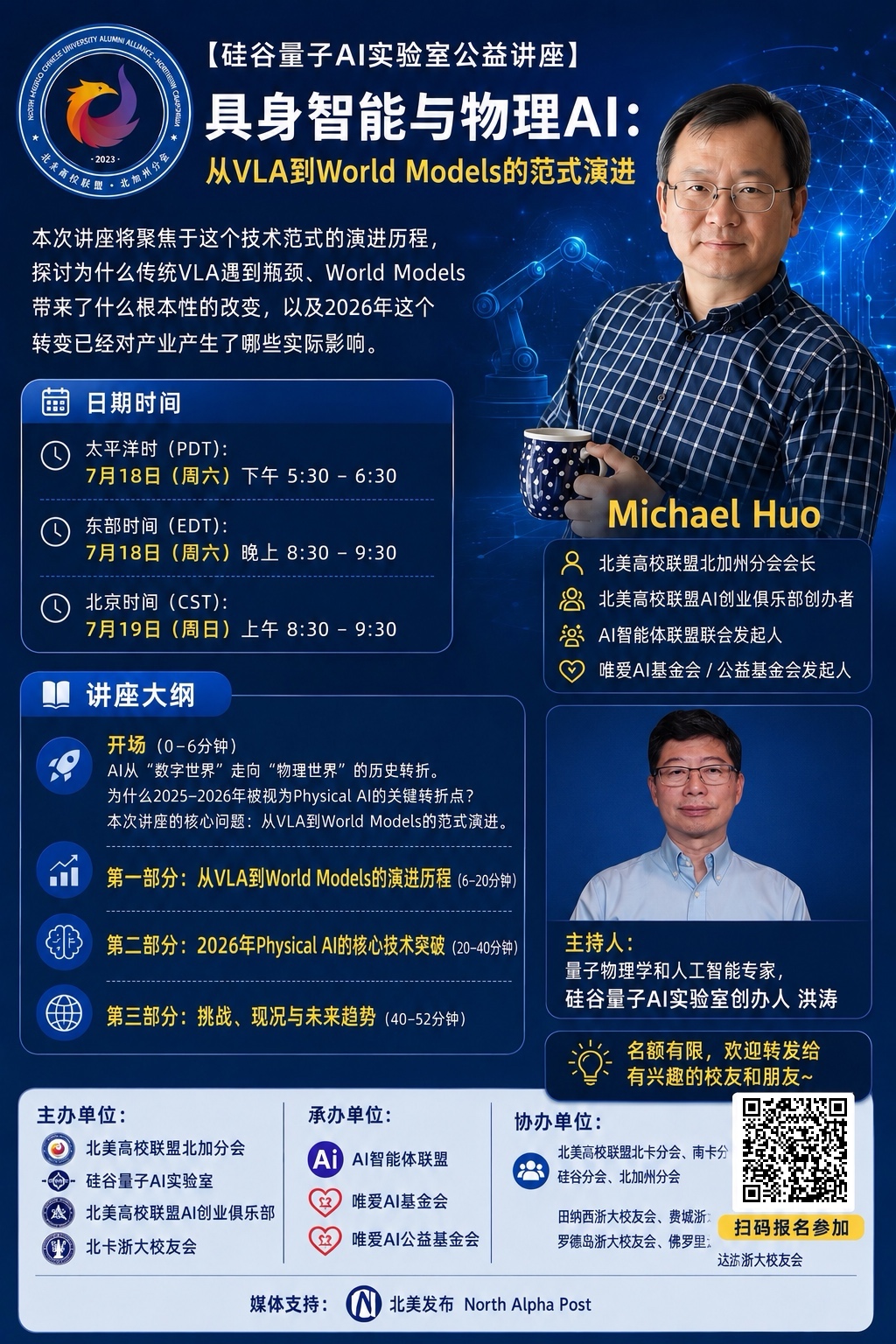
In our June 20 lecture, we introduced the core concepts of Embodied Intelligence and Physical AI and their latest development trends. However, as we look closer at recent industry dynamics, a major technical paradigm shift is taking place: from language-centric VLA (Vision-Language-Action) models to physical-prediction-centric World Models and World Action Models.
This lecture will focus on this technical paradigm shift, discussing why traditional VLA models face bottlenecks, what fundamental changes World Models bring, and how these changes are impacting the industry in 2026.
Date & Time
- Pacific Time (PDT): July 18 (Saturday) 5:30 PM – 6:30 PM
- Eastern Time (EDT): July 18 (Saturday) 8:30 PM – 9:30 PM
- Beijing Time (CST): July 19 (Sunday) 8:30 AM – 9:30 AM
Lecture Outline
Introduction (0–6 mins)
- The historical transition of AI from the “digital world” to the “physical world.” Why 2025–2026 is considered a critical inflection point for Physical AI. The core focus: the paradigm evolution from VLA to World Models.
Part 1: Paradigm Shift from VLA to World Models (6–20 mins)
- Advantages and limitations of traditional VLA models.
- Why the industry is looking for new technical paradigms.
- Core concepts and background of World Models.
- How World Action Models (WAMs) break through VLA limitations.
Part 2: Core Technological Breakthroughs in 2026 Physical AI (20–40 mins)
- Latest updates on NVIDIA Cosmos 3 and World Foundation Models.
- Advantages of World Action Models in generalization and physical prediction.
- Real-world deployment of major humanoid robotics platforms (Figure, Tesla Optimus, Boston Dynamics Atlas, etc.).
- Joint applications of digital twins and Physical AI.
Part 3: Challenges, Status & Future Trends (40–52 mins)
- The biggest remaining challenges for Physical AI today.
- Integration trends between VLA and World Models.
- Development path predictions for 2026–2030.
- Practical implications for businesses and creators.
Summary & Live Q&A (52–60 mins)
Resources & Materials
- Lecture Replay (YouTube Playlist): Watch Replay
- Slides & Technical Whitepapers: Available on zju.fyi
- Hosts: Silicon Valley Quantum AI Lab, NACUAA AI Venture & Impact Club, Zhejiang University Alumni Association of North Carolina (ZJUAANC).
- Organizers: AI Agent Alliance, VI AI Foundation, VI AI for Good Foundation.
- Co-organizers: NACUAA North Carolina Chapter, South Carolina Chapter, Silicon Valley Chapter, Northern California Chapter, ZJU Alumni Association of Tennessee, ZJU Alumni Association of Philadelphia, ZJU Alumni Association of Rhode Island, ZJU Alumni Association of Florida.
- Media Support: North Alpha Post